

A few nights ago I dreamed I was back in my grandmother’s garden, the one place that held so much of my childhood in one small plot of land. My father was there with me, which felt like a real gift, to see him again even if only in my mind’s eye. It felt real, like old times, full of my dad’s teachings. Before the left us, taken quickly and cruelly by pancreatic cancer, we’d asked him to find a way o visit and continue to teach us, if his consciousness continue to exist in some form “on that another side”.
A neighbor of ours, who was like a little sister to me and for whom my dad was something like an uncle through her whole childhood, had a dream right after he died and made a point of telling us about it. She saw him holding mushrooms, and later, a bottle of spoiled milk. I found myself wondering if he was pointing us toward a fungal thread in his own cancer. There’s a small but real body of research looking at whether antifungal compounds like ketoconazole might interact with tumor growth, though it’s early science, far from settled, and nothing anyone should read as a treatment claim.
Back in my own dream, part of the garden had become water, rimmed with rocks and river plants. In it was a fish, black-skinned, unlike anything I’d seen. I asked my father if it was safe to eat. He said, I don’t know. That answer stopped me. He had been a fisherman among other things, one of the ways our family got through the scarcity of communism, and he almost never didn’t have an opinion about what came out of the water. Then he pointed me toward mounds of shells, clams, oysters, a few scallops, and I said we could eat those instead. That’s when he showed me the worms moving through them. I came out of the dream with the feeling that none of it, the fish or the shellfish, was actually safe to eat. Then I noticed dark red mushrooms growing all over the garden, the same image returning. I don’t know if that means anything. Maybe it’s just my mind circling back to mycology, which has quietly become a thread running through so much of my own work. But I like to imagine, in the loose, unprovable way you’re allowed to when you’re grieving, that the mushrooms were trying to tell me something too.
I told my sister about the dream the next morning, the way you tell someone a dream because it won’t let go of you. I almost didn’t write about it here. It felt too private, too much like reading tea leaves. Then a few days later, a study crossed my feed about black lesions on catfish in New England lakes, and I couldn’t shake the eerie coincidence.
Here’s what the study actually found, and why I think it matters far beyond the fish.
The catfish with the black spots
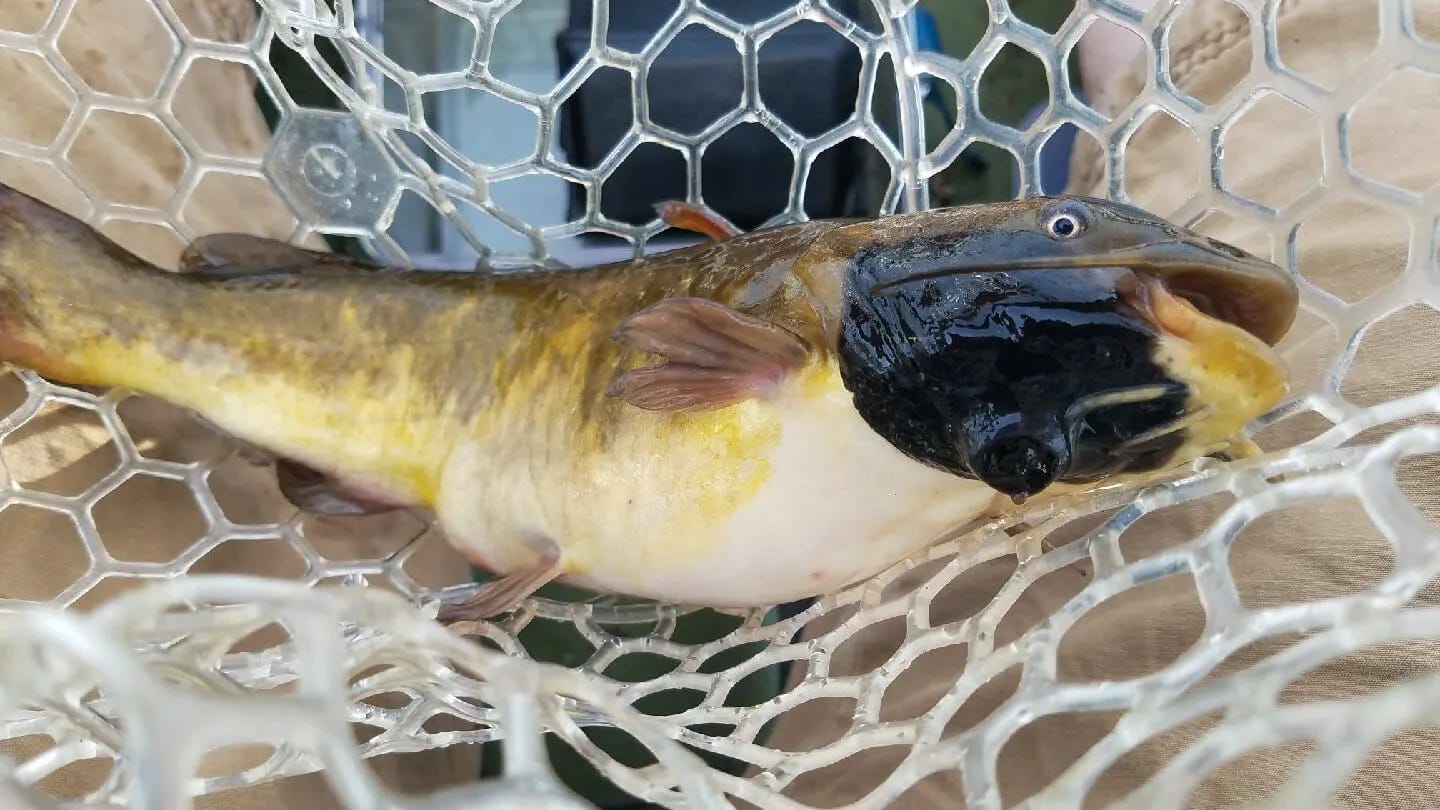
Researchers at the University of Vermont, publishing in Nature, have identified a transmissible cancer in brown bullhead catfish living in Lake Memphremagog, on the Vermont-Quebec border, and in a growing list of other lakes across New England and Canada. The lesions were first noticed by anglers back in 2012. By 2014, close to a third of the lake’s bullheads carried them.
The scientists initially suspected a virus or a pollutant-linked skin condition, since brown bullheads are considered indicator species for water quality. What they found instead was melanoma, a skin cancer normally associated with sun exposure, in a bottom-dwelling, scaleless fish that spends its life along dark lake sediment. That mismatch alone should tell you something: whatever is driving this, the sun has nothing to do with it. The fish that get it live where the sun doesn’t reach.
Whole-genome sequencing turned up something stranger still. The tumor cells across different fish were more genetically similar to each other than to the fish they were living in, the signature of a cancer that spreads cell to cell, like a parasite, rather than arising independently in each animal. This makes it only the fourth transmissible cancer ever documented in any species, after the facial tumors wiping through Tasmanian devil populations, a venereal tumor in dogs, and leukemia-like cancers in shellfish, and the first ever found in a freshwater fish.
The researchers suspect it spreads during spawning, when bullheads cluster in shallow water and make close physical contact, or through the sediment they burrow in. They’ve now traced the disease into Maine, New Hampshire, and New Brunswick, and they’ve found a possible historical fingerprint in Henry David Thoreau’s own journals. In 1852, on the Concord River in Massachusetts, he described a catfish with a black spot on its fin, and six years later a fish with what he called an inky black leprosy across half its head. Massachusetts, it turns out, may be where this disease was first written down.
Why arsenic doesn’t fully answer it
The study’s authors did find elevated arsenic in the tumor cells, and the geographic spread of the disease roughly tracks with naturally high arsenic soils in Vermont’s Northeast Kingdom and up through Maine. Arsenic is a real, well-documented carcinogen, and I don’t think the researchers are wrong to flag it.
But arsenic has been sitting in that bedrock for thousands of years. Thoreau’s fish were swimming in the same watershed in 1852. If arsenic alone explained this, we’d expect to have seen widespread outbreaks long before 2012. Something changed in the last few decades that didn’t exist before, and arsenic isn’t a new arrival. It’s the same actor that’s always been on stage. The question worth asking is what new substance walked into the room with it.
My own suspicion lands on the chemical load we’ve added to that landscape in the last half century: agricultural pesticides and insecticides, and PFAS, the “forever chemicals” that don’t break down and don’t leave. This isn’t a wild guess. A 2026 USGS model of soils across Maine, Vermont, and New Hampshire found that roughly 73 percent of soil samples exceeded New Hampshire’s remediation threshold for PFOS, and 41 percent exceeded it for PFOA, in areas with no obvious industrial source nearby. Separate USGS groundwater sampling across the eastern U.S. found PFAS in 60 percent of public-supply wells and 20 percent of private domestic wells tested. Nationally, PFAS has now turned up in drinking water serving over 176 million people. None of that proves PFAS causes this specific melanoma. But it establishes that these lakes and the soil around them are carrying a chemical burden that didn’t exist when arsenic was the only story anyone had to tell.
What the dream already knew
A few of the details line up closely enough with the actual research that I want to sit with them instead of moving past them.
The researchers didn’t describe this melanoma as a normal tumor. They described it as a cancer that spreads cell to cell, fish to fish, closer in behavior to a parasite than to conventional cancer. That is close to the exact word my mind reached for on its own, watching worms move through those shells. And the shells themselves weren’t a random detail either. The same paper situates the catfish disease alongside the only three other transmissible cancers ever documented in animals, and one of those three is already a leukemia-like disease known to move through clams, mussels, and other bivalves. My dream put something crawling through shellfish. The actual science had already found a transmissible cancer living in shellfish, years before this catfish study. I didn’t know that fact when I had the dream. I only found it while writing this.
I also don’t think it’s a coincidence that I woke up with the sense that none of it was safe to eat, not the fish and not the shellfish. Whatever that instinct was drawing from, dread, memory, something else, it wasn’t wrong about the water being the thing in question.
The mushrooms are harder to place, and I want to be honest about that rather than force a fit. A transmissible cancer living in lake sediment isn’t a fungal disease, and I’m not going to claim otherwise. But you asked me a fair question separately: could fungal toxins actually reach a lake through rain runoff. The answer is yes, and not as a stretch. Fungicides, the fungal-targeting counterpart to the herbicides and insecticides everyone already worries about, wash off treated fields into nearby waterways every time it rains, the same way the other pesticide classes do. One survey of European surface waters actually found fungicide concentrations running higher on average than either herbicides or insecticides. Separate testing of ponds and lakes has turned up fungicide residues as high as 6 micrograms per liter in the water itself and close to 100 micrograms per kilogram in the sediment, which matters here because sediment is exactly where a bottom-dwelling, scaleless fish spends its entire life. None of that means a fungicide caused this melanoma. But it means the fungal thread in the dream isn’t as far-fetched as it first sounds. It just may be present as a passenger and a stressor rather than as the driver.
The part that worries me for us, not just the fish
Here’s where I want to be careful, because I don’t think this cancer is coming for people the way it moves through catfish. Transmissible cancers are rare precisely because most animals, humans included, have highly diverse immune recognition genes that treat foreign cells, cancerous or not, as something to attack and reject. It’s the same system that makes organ transplants require careful matching. Species like Tasmanian devils that developed this disease had unusually low genetic diversity in exactly those immune genes, which is part of why the tumor could spread unchecked through their population. Humans don’t share that vulnerability. The fish study’s own authors say plainly there’s no known risk to people, and I take that at face value.
What I don’t think we can wave off is the broader pattern the fish are sitting inside of. Early-onset cancers, cancers showing up in adults under 50, have been rising steadily and are now increasing by roughly 3 percent a year in colorectal cancer alone, with close to 1 in 6 new colorectal cancer cases in the U.S. this year expected in someone 49 or younger. Researchers studying this trend keep landing in the same place: genetics move too slowly to explain a shift this fast, so something in the environment shifted instead. Scientists tracking early-onset breast cancer have found that women exposed in the womb or in infancy to the pesticide DDT show a measurably higher risk decades later. Indoor air pollution exposure in early life has been linked to changes in breast tissue density in adolescence. Nearly half the U.S. population lives somewhere with unsafe air pollution levels, and an estimated 200 million Americans are drinking water carrying PFAS.
None of this is a single smoking gun. That’s actually the point. What the bullheads may be showing us, in a body and a timeline small enough to study closely, is what a landscape does to the things living in it once you’ve layered enough new chemistry onto old geology. Arsenic was always there. What wasn’t always there was everything else we added on top of it.
Back to the garden
I don’t know if my father was reaching through a dream to warn me about catfish in Vermont, or mushrooms, or anything at all. Grief works in strange, associative loops, and I don’t fully trust my own explanations for what I see when I’m missing someone this much. But I don’t think a thing has to be fully explained to mean something. Maybe he was pointing at something real, both in that catfish research and in the quieter work I keep circling back to with mushrooms. Or maybe the two threads of my life, the environmental reporting and the private grief, are just weaving themselves together in my sleep, because that is what minds do with the people they’ve lost. Either way, I keep coming back to the image of those shells, clean and abundant on the outside, and what was moving inside them once you looked closely. That feels like an honest description of where we are with a lot of our water right now. Abundant. Familiar. Worth a second look before you decide it’s safe.
Source: https://www.uvm.edu/uvmnews/news/more-parasites-tumors-vermont-scientists-discover-transmissible-cancer-catfish