

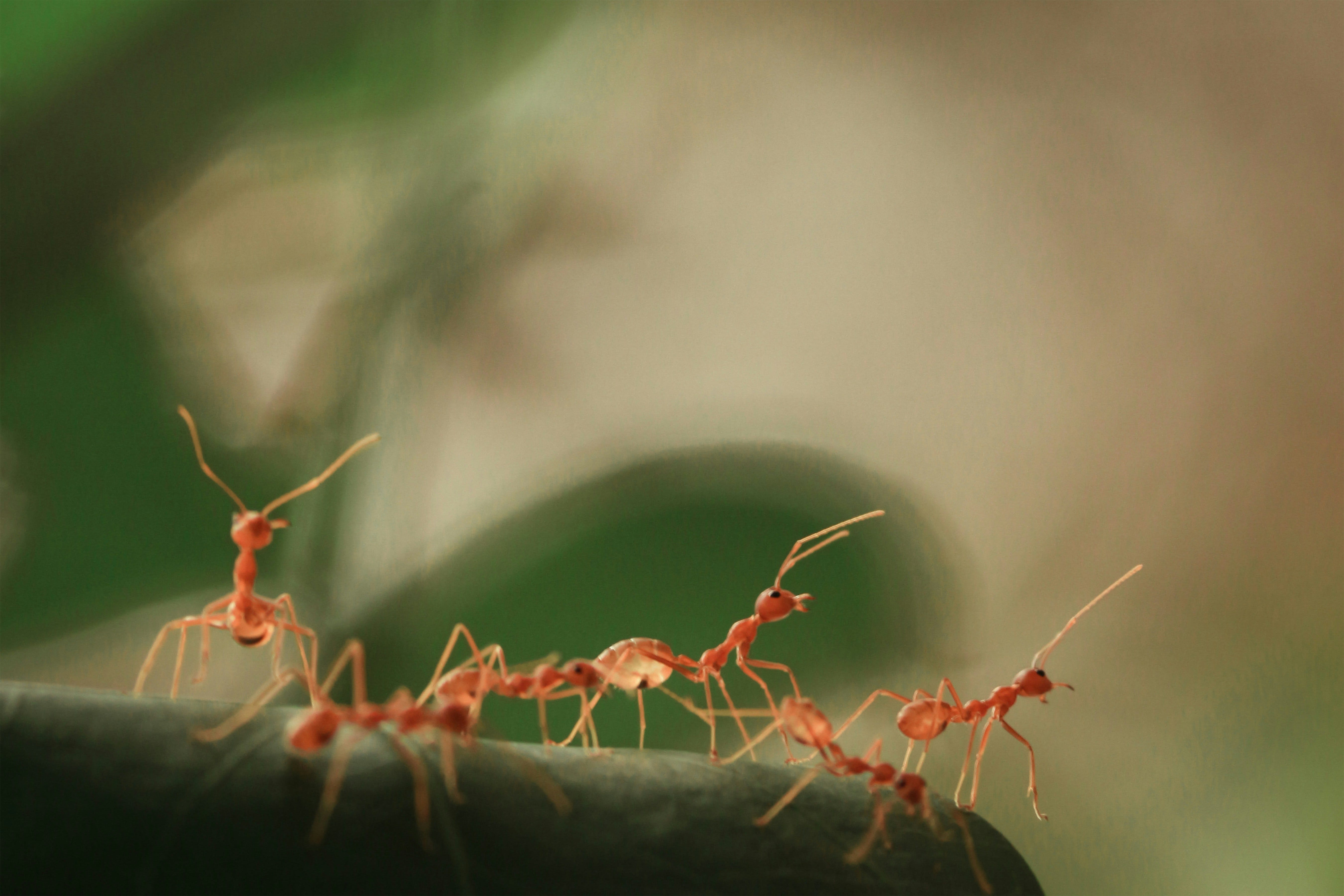
Photo by Prince Patel on Unsplash
In the dense, humid understory of the Amazonian rain forest, something deeply unsettling is happening to the ants.
A carpenter ant, Camponotus leonardi, goes about its morning, foraging along a tree branch forty feet above the forest floor, when something invisible begins to redirect it. A fungal spore, from the species Ophiocordyceps unilateralis, has landed on its exoskeleton and begun its quiet infiltration. Within days, the ant descends. It doesn’t wander. It doesn’t drift. It travels to a very specific height above the ground, typically between 20 and 30 centimeters, dictated not by instinct or colony instruction, but by the optimal temperature and humidity the fungus requires to reproduce. The ant clamps its mandibles around a leaf vein with a bite strength it has never used before. And there it stays.
The fungus blooms from its head.
This is not science fiction. It is one of the most documented examples of behavioral manipulation in all of biology, studied extensively by mycologist David Hughes at Penn State University, whose research has shown that the fungus effectively commandeers the ant’s motor neurons while leaving its brain tissue largely intact. The ant is not confused. It is not sick in any ordinary sense. It has simply been rerouted, its behavior in perfect service of a biological agenda that is not its own.
I’ve been thinking about those ants a lot lately.
The Quiet Takeover
Most of us were taught to think of ourselves as sovereign creatures: our choices our own, our cravings internal signals, our moods generated by events in our lives. But a growing body of research in microbiology, neuroscience, and environmental medicine is complicating that picture in ways that should make us pause.
The human gut contains approximately 38 trillion microbial cells, roughly equal to the number of human cells in the body, according to a landmark 2016 recalibration published in Cell. These organisms are not passengers. They produce neurotransmitters. They communicate with the vagus nerve. They influence immune function, appetite, mood, and cognition through pathways that researchers have only recently begun to map.
The gut-brain axis, the bidirectional communication network linking the enteric nervous system to the central nervous system, has become one of the most active research frontiers in medicine. Studies have demonstrated that gut microbiome composition correlates with depression, anxiety, and even personality traits. A 2019 study published in Nature Microbiology found associations between specific gut bacterial populations and self-reported quality of life. Other research has linked disruptions to the microbiome to chronic fatigue, brain fog, and compulsive food-seeking behavior.
Including, notably, the compulsive seeking of sugar.
Candida and the Sugar Signal
Here is where the hypothesis gets personal, and gets interesting.
Candida albicans is a yeast that naturally inhabits the human gut in small, managed populations. Under ordinary conditions, it is benign, held in check by competing bacterial species. But when the microbial balance tips, after a course of antibiotics, during a period of chronic stress, following a diet high in refined carbohydrates, and we often see it raise with certain environmental exposures…Candida can proliferate into what practitioners of integrative medicine call “overgrowth.”
The Candida overgrowth hypothesis is contested in conventional medicine, which tends to recognize only the most severe fungal infections. But what’s less contested is this: Candida metabolizes sugar. It thrives on it. And there is emerging (if not yet conclusively proven) evidence that gut dysbiosis, including yeast overgrowth, can influence food cravings through the gut-brain axis, effectively creating a feedback loop in which the organism drives the host toward the very substrate it needs to flourish.
“The microbiome is not just responding to what you eat,” gastroenterologist Dr. Emeran Mayer, author of The Mind-Gut Connection, has written. “It is actively shaping your food preferences.”
Is that so different from the ant?
The fungus that colonizes Camponotus leonardi doesn’t kill its host immediately. It steers it. It keeps it alive just long enough to position it exactly where the fungus needs to be. The manipulation is metabolic, neurological, and environmental all at once.
When I was in the grip of a sugar addiction I couldn’t explain and couldn’t break, I wonder now whether I was, in some meaningful sense, being steered.
Place as Interruption
This brings me to the theory I keep returning to, one that sits at the intersection of microbiology, environmental medicine, and the core question of this blog: what does location do to the body?
Here is the hypothesis: when you move to a genuinely new environment, you don’t just change your scenery. You change your microbial inputs. You change the airborne fungal spores you inhale, the soil bacteria you’re exposed to, the food sources available to you, the ambient humidity and temperature your internal microbiome is calibrating against. You interrupt the ecosystem that has established itself inside you.
This is not entirely speculative. Research in environmental microbiology has shown that the composition of indoor and outdoor microbiomes varies dramatically by geography. A home in the humid American South harbors different fungal communities than one in the arid Southwest. A coastal New England kitchen, damp, salt-adjacent, seasonally cold, is a different microbial world than a high-altitude inland apartment. When you move, you don’t just bring your body. You bring your internal colonies into contact with a new environmental community, and the negotiation that follows may be profound.
There’s a concept in ecology called “community displacement,” the idea that an established microbial community will resist invasion by foreign species, and that only a sufficiently disrupted environment allows new species to take hold. This works both ways. A colony that has established itself in your gut over years of living in one place may find itself destabilized when its external reference signals, the ambient spores, the local foods, the regional water chemistry, are no longer present. Without reinforcement, without the environmental context that helped it consolidate, it may simply not persist.
The new place, in other words, might not just be neutral. It might be actively inhospitable to what was living in you before.
The Six-Hour Feeling
I have always driven toward air.
Not a destination, exactly. Not a city or a coast or a specific address. Something more instinctive than that. A pull toward places where the atmosphere felt different in my lungs, where rolling down the window meant something other than just wind.
I have done this my whole life without fully understanding why. Long drives that didn’t need to be long. Routes chosen for no reason I could name. Stopping somewhere and stepping out of the car and just breathing, checking the air the way you’d check water temperature before swimming. Sometimes it was right. Sometimes it wasn’t. I always knew within a few breaths.
There is usually a moment, somewhere around hour five or six on a drive that’s taking me somewhere genuinely new, where something shifts. The air coming through the vents changes character. It still carries fungus, because living air always does, the spores of decomposition and growth that are the breath of any landscape, but it isn’t the fungus I know. It isn’t the particular damp signature of the place I left. It is unfamiliar, and my body notices before my mind does.
That unfamiliarity feels like relief.
I have spent a lot of time wondering why.
What We Don’t Know
I want to be clear: the idea that residential relocation disrupts and potentially displaces internal fungal or microbial colonies that have been behaviorally shaping their hosts is a hypothesis. A fascinating one, supported by adjacent research, but not yet tested directly in the way a rigorous clinical study would require.
What we do know:
The human microbiome is dynamic and environmentally responsive. Geographic relocation produces measurable changes in gut microbiome composition. A 2018 study in Cell tracking Southeast Asian immigrants to the United States documented significant microbiome westernization within months of arrival. Internal fungal communities (the “mycobiome”) are understudied but real. Research published in Nature has found that gut fungi are not passive, and may interact with bacterial communities in ways that affect host immune and metabolic function. Behavioral influence via the gut-brain axis is documented in animal models and increasingly implicated in human studies. Environmental microbiomes vary significantly by region, climate, and built environment.
What we don’t know is whether the loop closes the way I’m imagining it, whether an internal fungal or microbial colony that has been subtly steering behavior toward environments that suit it can be interrupted by relocation, and whether the psychological “unlocking” that many people report after moving has a literal microbial correlate.
But I think it’s a question worth asking.
The Location Effect, Literally
The premise of this article is that place shapes health, not metaphorically, but physiologically. The geography, air quality, built environment, and ecological community you inhabit is not background to your health story but a co-author of it.
The zombie ant is an extreme case. But extremity in biology often illuminates the norm. If a fungus can commandeer an ant’s motor neurons and march it to the correct altitude with millimeter precision, the question isn’t whether microorganisms influence host behavior. The question is how much, and which ones, and what happens when you take the host out of the environment the colony was tuned for.
I suspect the answer, when we eventually have the tools to measure it properly, will be stranger and more interesting than we expect.
And I suspect some of what we call personality, preference, and craving will turn out to be, at least in part, somebody else’s agenda.
Move anyway.
The Location Effect explores how geography and physical environments shape human health. If you’ve experienced a shift, physical or psychological, after relocating, I’d love to hear about it.
What I love about biology is that oftentimes the answer can be, yes and yes. I was surprised that you did not mention either Light or Magnetism.