

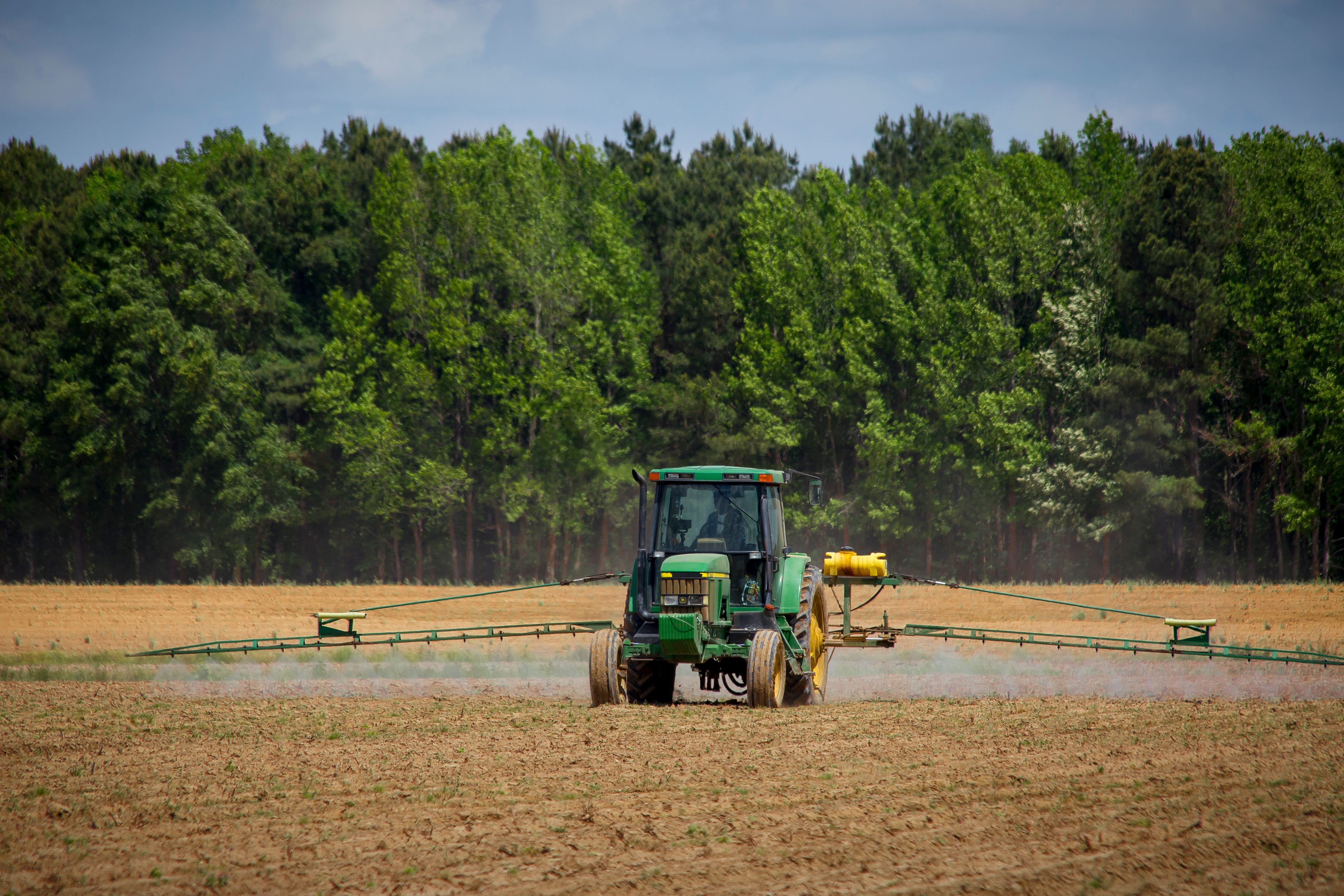
On June 25, President Trump stood in the Oval Office with Health and Human Services Secretary Robert F. Kennedy Jr. and Agriculture Secretary Brooke Rollins to sign an executive order promoting regenerative agriculture. The administration framed it as a turning point: soil health, farm resilience, and a food system built around fewer chemical inputs. Five days later, on June 30, the Environmental Protection Agency approved two new pesticides built from fluorinated chemicals for use on the country’s two most widely planted crops, corn and soybeans, with one also cleared for wheat.
To an outside observer, the two announcements might look contradictory. They came from the same administration within the same week. But they did not come from the same people, the same meetings, or, in any meaningful sense, the same decision-making process. That gap helps explain something larger about how federal policy is actually produced, and why the same government can appear to move in opposite directions at once.
## The week in question
The regenerative agriculture order directed HHS, USDA, and the EPA to build a joint research framework on cumulative chemical exposure in the food supply and launched a National Institutes of Health prize challenge aimed at reducing reliance on chemical crop protection. Rollins paired it with a finalized Regenerative Feedstock Rule connecting soil-health practices to premium biofuel markets for corn, soybeans, sorghum, and canola, building on a $700 million pilot program the department had rolled out the previous December. USDA noted that a majority of corn and soybean farmers already use at least one regenerative practice, and framed the rule as a market-based incentive rather than a mandate.
Then came the pesticide approvals. According to the Center for Biological Diversity, the EPA’s June 30 registrations covered diflufenican and epyrifenacil, two fluorinated compounds never before used in the United States, for corn and soybeans, with epyrifenacil also approved on wheat. The agency additionally expanded approved uses of a previously registered fluorinated pesticide, bifenthrin, to include coffee, kiwifruit, peas, kale, and broccoli. The timing drew particular scrutiny because the approvals landed just days after the Supreme Court sided with Bayer and the administration in a ruling that narrows Americans’ ability to sue pesticide manufacturers over alleged harms.
The EPA disputes the “forever chemical” label for these newer compounds. In a statement responding to what it called misinformation, the agency’s Office of Chemical Safety and Pollution Prevention said its 2023 regulatory definition of PFAS, which requires two or more fully fluorinated carbons, was developed through a public rulemaking process and that single-fluorinated-carbon compounds do not display the persistence associated with forever chemicals. The agency said its approved pesticides underwent the toxicity testing required under federal law and found no risks of concern when used as labeled.
That distinction matters, and it is genuinely contested. Advocacy groups counter that the EPA’s narrower definition departs from the one used by most states, written into past defense authorization law, and endorsed by more than 150 PFAS researchers internationally. Under that broader and more widely used definition, they argue, the newly approved compounds qualify as PFAS. Freedom of Information Act records cited by the Center for Biological Diversity show that a webpage initially acknowledging this conflict was revised weeks later to remove the caveat, with the changes reviewed by EPA Administrator Lee Zeldin.
## Who was actually in the room
Neither of these actions was made by “the EPA” or “the USDA” as monolithic entities. They were made by specific offices staffed by specific people, operating under different statutory mandates, different political sponsors, and different outside constituencies.
The regenerative agriculture push traces to HHS and USDA leadership aligned with the Make America Healthy Again coalition, a loose alliance that includes wellness advocates, some organic and regenerative farming interests, and food-system reformers skeptical of chemical-intensive agriculture. The pesticide registrations trace to the EPA’s pesticide program, where, according to reporting cited by public radio outlet KALW and confirmed across multiple advocacy filings, several senior political appointees came directly from the industries they now regulate: Kyle Kunkler previously lobbied for the American Soybean Association before becoming deputy assistant administrator for pesticides, working under Nancy Beck and Lynn Dekleva, both former American Chemistry Council lobbyists, under an office head who was confirmed with the chemistry council’s public endorsement.
This is not a story about one rogue office defying an otherwise unified administration. It is closer to the ordinary condition of the modern executive branch. Agencies are staffed through different appointment processes, subject to different congressional committees, and embedded in different professional and lobbying ecosystems. The people who negotiate soil-health incentives with farm groups are, in practice, rarely the same people who evaluate a pesticide’s toxicology data under the Federal Insecticide, Fungicide, and Rodenticide Act. A president’s executive order can set a broad direction, but the specific, technical determinations, like whether a compound clears a safety threshold, are made deeper in the bureaucracy, often years into a review process that predates the current political leadership.
## The pattern is not new, or one-sided
This isn’t the first time the same administration’s agencies have pulled in different directions on pesticide policy. In January, the EPA approved isocycloseram, another fluorinated insecticide, for use on a wide range of food crops including apples, tomatoes, and almonds, along with lawns and golf courses. The agency’s own data showed the compound reduced testicle size and sperm counts and caused liver damage in manufacturer-sponsored animal studies; Australian regulators separately found evidence of fetal skeletal malformations that the EPA disputed. Conservation groups sued in the Ninth Circuit, and the EPA’s own research indicated bees foraging near treated orchards could be exposed to roughly 1,500 times a lethal dose.
It is worth noting that criticism of the administration’s food and farm record has not come only from its usual opponents. David Murphy, a former top fundraiser for Kennedy’s own presidential campaign, praised the regenerative agriculture pilot program as a step forward but pointed out that USDA cut more than a billion dollars from farm-to-school and farm-to-food-bank programs the same year, calling it evidence there is still a long way to go. Robby Sansom, chief executive of the sustainable-agriculture group Force of Nature, made a related point: the federal Farm Bill, a program worth tens of billions of dollars, still effectively requires heavy chemical use for crop insurance eligibility, working against the very outcomes the new pilot is meant to encourage. In other words, even allies inside the MAHA-aligned coalition describe the government as internally inconsistent, not because any single official is acting in bad faith, but because different programs, written into law at different times under different pressures, are still running simultaneously.
## What the underlying science says
The stakes of the PFAS pesticide debate are not abstract. PFAS compounds are called forever chemicals because their carbon-fluorine bonds resist environmental and biological breakdown, allowing them to accumulate in soil, water, and human tissue over years of low-level exposure. A Harvard-led study of roughly 69,000 people exposed through contaminated drinking water found higher rates of certain cancers and metabolic disorders compared with unexposed populations, and controlled research has found measurable immune changes at relatively low serum PFAS levels. The Centers for Disease Control and Prevention and the National Academies of Sciences both maintain ongoing guidance on PFAS exposure risk, reflecting a scientific consensus that cumulative, long-term exposure, rather than any single dose, is the primary concern. Current pesticide approval frameworks are built around shorter-term toxicity testing, which is part of why the “no risks of concern” finding for a newly registered pesticide and the “This is a public health problem” framing from environmental groups can both be technically defensible descriptions of the same approval, depending on which time horizon and which regulatory definition is applied.
## The deeper question
There is a natural conclusion to draw from all of this: that better outcomes depend on installing people with genuine principle into positions of power, and that a sufficiently independent-minded leader might simply be less movable by industry pressure than the system around them. There is something to that. Individual character matters, and agencies are run by individuals. But the pattern described above suggests something more structural is also at work. Even a cabinet secretary who is personally resistant to industry influence does not personally review pesticide toxicology files or approve individual chemical registrations. Those determinations sit several layers down, inside offices where, on the pesticide side of this story, several of the most senior technical positions have been filled by people who came directly from the industries under review. A leader’s convictions can set the tone at the top of an agency without necessarily reaching the office two floors down that signs off on a chemical registration.
This is the argument political scientists and legal scholars have made for decades under the banner of regulatory capture: that agencies tasked with overseeing an industry can gradually come to reflect that industry’s interests, not through corruption in the criminal sense, but through the ordinary mechanics of expertise, staffing, and access. The people with the deepest technical knowledge of a chemical’s registration pathway are often the people who spent their careers inside the companies seeking that registration. That is a structural feature of how technical regulation works, not a claim about any individual’s honesty.
None of this means the regenerative agriculture push is hollow, or that the pesticide approvals are indefensible on their own terms. It means the federal government is not one actor with one intention. It is a federation of offices, each with its own leadership, statutory obligations, professional culture, and outside relationships, occasionally pointed in the same direction by a president’s signature, but just as often left to pursue their separate mandates on separate timelines. Understanding policy as the product of that fragmented system, rather than as a single coherent strategy, is a more accurate way to read weeks like this one, and a better starting point for anyone trying to change the outcome.
---
**Sources**
- Center for Biological Diversity, “Trump EPA Approves Two More ‘Forever Chemical’ Pesticides for Use on Most Widely Grown U.S. Crops,” June 30, 2026
- Common Dreams, “’A National Outrage’: Days After Monsanto Ruling, Trump EPA Approves More Forever Chemical Pesticides,” June 30, 2026
- Earthjustice / Center for Biological Diversity, “Lawsuit Challenges Trump EPA’s Latest Approval of ‘Forever Chemical’ Pesticide,” January 15, 2026
- Public News Service, “Suit challenges EPA approval of new ‘forever chemical’ insecticide,” January 26, 2026
- U.S. EPA, “FACT CHECK: EPA Debunks False Claims that Agency Recently Approved ‘Forever Chemical’ Pesticides”
- KALW, “EPA approves pesticides containing forever chemicals for use on food,” January 5, 2026
- The Washington Post, “EPA moves to approve new ‘forever chemical’ pesticides,” November 22, 2025
- USDA, “President Trump Signs Executive Order Advancing Regenerative Agriculture; Secretary Rollins Announces USDA Rule to Unlock Billions for American Farmers,” June 25, 2026
- HHS.gov, “President Trump Signs Executive Order Advancing Regenerative Agriculture as Part of Make America Healthy Again Agenda,” June 25, 2026
- AgWeb, “USDA Launches New $700 Million Regenerative Ag Pilot Program,” December 2025
- AgFunderNews, “’Investing in regenerative and organic is not a political stance’: agrifood reacts to USDA’s regen ag pilot,” December 12, 2025
- MEAT+POULTRY, “USDA, HHS promote regenerative agriculture under new rule,” June 26, 2026
*Note on sourcing: Several claims above rely on findings and framing from advocacy organizations (the Center for Biological Diversity, Earthjustice, Center for Food Safety) whose stated mission is to challenge these approvals, alongside the EPA’s own public rebuttal. Readers should weigh both sides; a link to primary source documents (EPA registration decisions, the executive order text, and the underlying FOIA records) is recommended before publication.*