

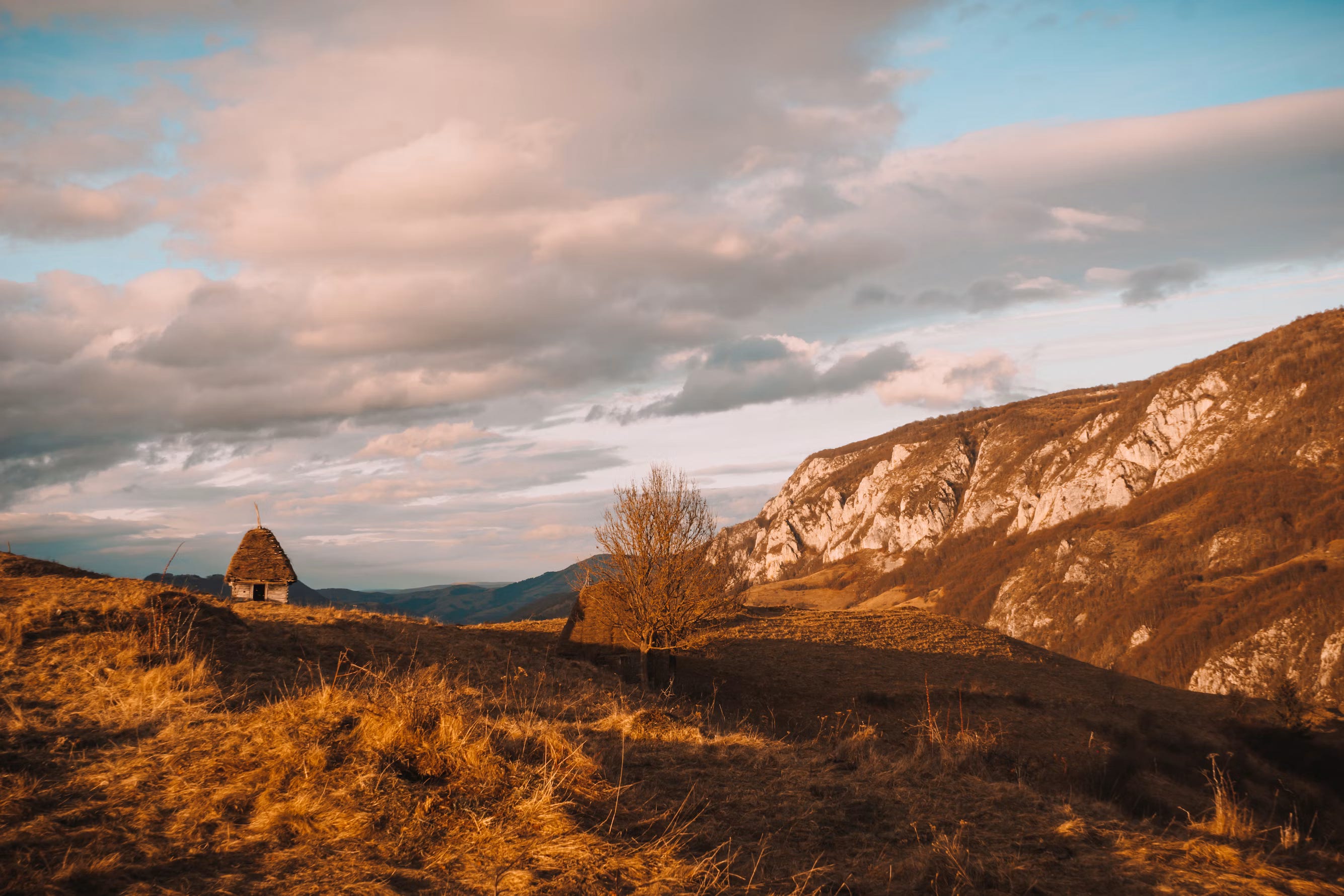
My grandmother almost never left her village. She went to the city a handful of times in her life, mostly for doctors’ visits. When she came to see us, in our concrete block apartment, she got antsy almost immediately. She loved us, but she could not wait to get back to her house in the mountains, to her garden, to the particular air that was hers. She also had severe motion sickness, bad enough that a car ride could undo her for a day. I have a version of it. So, it seems, does my daughter. Three generations, the same body telling the same story: we were not made to be moved around this much.
I think about her often now, because I have become, in my own more modern and more medicalized way, someone who also cannot simply go anywhere. An illness rewired my tolerance for the built environment, and what used to be background noise, the fragrance aisle, the freshly sealed parking lot, the neighbor’s pesticide truck, now registers as an event my body has to recover from. I call these outings incursions, only half joking. An errand, a hospital visit, an afternoon in a town two exits over, and I come home flattened for a day or two. My husband, who is healthier and restless and reasonable, wants to see places. I understand him. I was, before this, a fairly well traveled person myself, and I am grateful for every mile of it. But something in me has quietly agreed with my grandmother, decades late: if the cluster you already have is good enough, the roots, the family, the garden, the particular slant of light on your own street, maybe that is the whole assignment. Maybe going everywhere was never actually the point.
My own cluster, the town and the string of towns around it, gives me almost everything a person could want. There is real natural beauty here, real gardens, a working art scene, a city forty minutes away with concerts and a genuine food culture. On paper it looks like abundance, but from my perspective, it is hardly the case. And summer changes the math. Heat and humidity together push up airborne mold and bacteria levels indoors, a relationship detailed enough that researchers have started building predictive models for exactly which temperature and humidity combinations tip a building into unsafe bioaerosol territory. At the same time, warm, wet conditions are prime growing season for the fungi that produce mycotoxins outdoors, in soil, mulch, and lawns. And it is, not coincidentally, the season when pesticide use ramps up hardest, on lawns, on golf courses, on town rights of way, on the ornamental gardens that make my area so pretty from the road. So the very months that should be the most rewarding here become, for a nervous system like mine, the most loaded. The beauty and the burden arrive in the same package.
It is tempting to think this is a private, unlucky quirk of my own biology. It is not entirely. There is a whole population of people, mostly invisible to everyone around them, who have been pushed out of ordinary housing and ordinary towns by exactly this kind of exposure, and who have ended up living something closer to a nomadic life as a result. People with multiple chemical sensitivity have described losing careers, homes, and marriages after their bodies stopped tolerating fragrance, laundry exhaust, new carpet, or pesticide drift, the everyday chemistry of modern life that the rest of folks don’t notice. One well known account describes an entire informal community in the American Southwest, people who relocated in search of a place with genuinely clean air, only to become nomadic again when their new town developed allergenic vegetation or nearby construction. A survey of people living with the condition found that nearly all of them had to take special precautions inside their own homes just to make the air livable, and most said they would move again in an instant if safe housing existed. These are not fringe anecdotes so much as an early signal. As the built and chemical environment gets denser, more scented, more sprayed, the number of places that qualify as genuinely tolerable keeps shrinking, and the people most sensitive to that shrinkage are the first to feel it and the first to have to move because of it.
That is the part of this story that I think a wider audience needs to sit with, the part that goes beyond any one person’s illness. We are, collectively, making it harder to find a good place to put down roots. Not through some single dramatic event, but through accumulation: a pesticide season a little longer than last year’s, a new development where a meadow used to buffer the wind, another synthetic fragrance in another laundry product, another building sealed too tightly to breathe. It is quietly displacing a small population of unusually sensitive people right now, and it is a preview, not a separate story, of pressures that will eventually reach less sensitive people too, just on a longer timeline. The nomads of the chemically intolerant world are, in that sense, an early warning system for the rest of us, the canaries who already had to leave the coal mine.
And yet the research on place attachment argues, gently, for the opposite instinct, for staying rather than fleeing wherever possible. People who remain rooted in one place long enough tend to develop real emotional and psychological benefits from it, a sense of belonging and identity that researchers call rootedness, and that rootedness appears to buffer stress and support well being, particularly later in life. Studies on residential mobility have found that disruption from moving is not just a short, sharp shock that fades; the health consequences can unfold slowly, over years, as a person’s whole social and practical infrastructure has to be rebuilt from scratch. In other words, the constant motion our culture treats as freedom, and even as a kind of achievement, may carry a cost we rarely account for. We have built an entire identity around the idea that we are entitled to experience everywhere, that a good life requires seeing as much of the world as possible. That idea is barely a century old, made possible only by cheap flight and cheap fuel, and I am no longer sure it is either good for us or actually necessary.
I do not say this from a place of resentment toward my husband, who deserves to see the world, or toward the version of me that once did too. I say it because I have quietly run the experiment on my own body and gotten a clear result. I have traveled. I have also come home from a two hour errand feeling like I ran a race I did not train for. Somewhere in between those two facts is a truth my grandmother lived without ever having to argue for it: a good cluster, tended and known and returned to, might be worth more than a hundred good clusters glimpsed once and left behind. She had her village, her garden, her family coming to her instead of the other way around. She got carsick if you took her too far from it, and she never seemed to think that was a defect. It was, maybe, just her body agreeing with her mind about where she was supposed to be.
I have seen enough. I have done enough. What I am looking for now is not another place to visit. It is a town with genuinely good air, the kind my body does not have to recover from, the kind I could simply live inside of and never have to leave. My grandmother found hers in the mountains, without ever calling it a philosophy. I am still looking for mine. But I suspect that when I find it, I will understand, finally, exactly what she knew.
Sources referenced
Zhang et al., “Emotionally Healthy Ageing-in-Place: Residential Normalcy, Place Attachment and Mental Well-Being of Elderly Migrants,” Population, Space and Place, 2025
“Residential Place Attachment as an Adaptive Strategy for Coping With the Reduction of Spatial Abilities in Old Age,” National Institutes of Health / PMC
Research summary, “Does Place Attachment Affect Social Well-Being?” (residential mobility and long-term health effects)
“The Effect of Housing on Individuals with Multiple Chemical Sensitivities,” compiled survey data (Gibson et al., Davis et al., Caress and Steinemann, among others)
“No Safe Haven: People With Multiple Chemical Sensitivity Are Becoming the New Homeless,” reporting on MCS communities in the American Southwest
ScienceDirect, “Revisiting the Joint Effect of Temperature and Relative Humidity on Airborne Mold and Bacteria Concentration in Indoor Environments,” 2025
“Climate Change and Effects on Molds and Mycotoxins,” PMC
23andMe genome-wide association study on motion sickness, published in Human Molecular Genetics, 2015
MedlinePlus Genetics, “Motion Sickness”