

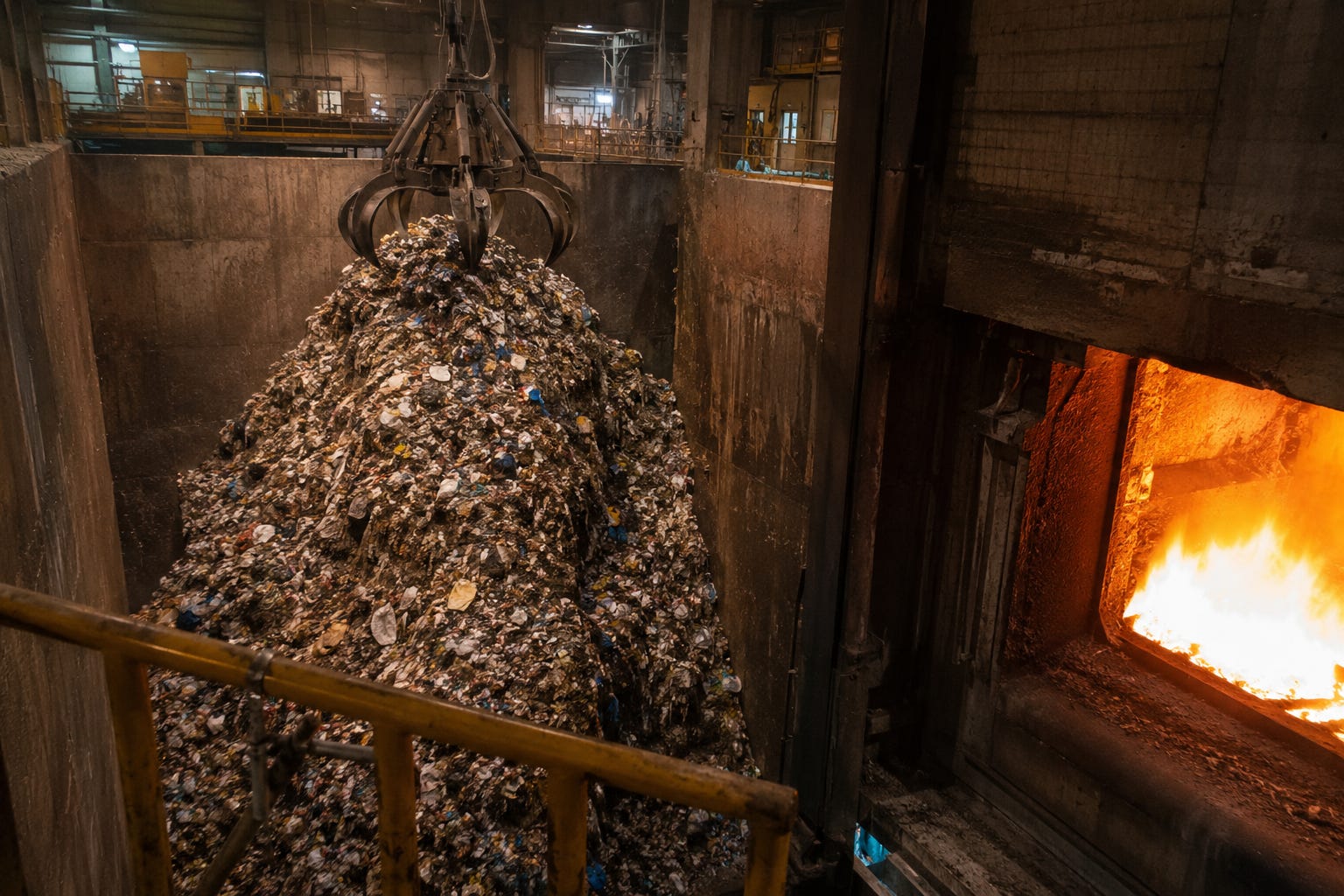
Every day, somewhere in America, a mountain of garbage disappears into fire. The stack above the plant releases a plume into the sky, and the plume drifts. It drifts over the elementary school on the corner. It settles into the soil of the community garden two blocks away. It enters the lungs of the child waiting at the school bus stop. This is not a hypothetical. This is Tuesday.
There are roughly 60 to 72 municipal solid waste incinerators still operating in the United States, depending on the year and the counting method. They are concentrated in the Northeast, Florida, and the upper Midwest. They burn somewhere between a quarter and a third of a million tons of garbage every year. And according to research from the Tishman Environment and Design Center at The New School, approximately 4.5 million Americans are exposed to their pollution, with 80 to 85 percent of those facilities located in environmental justice communities, meaning low-income neighborhoods, communities of color, or both.
The industry prefers to call these plants “waste-to-energy” facilities, a term that describes the electricity some of them generate as a byproduct of combustion. The framing is deliberate, and it works: it conjures images of clean modern technology transforming society’s discards into something useful. The reality, as decades of epidemiological research suggest, is considerably darker. What goes up these stacks comes back down. The question that too few people ever get to ask before moving near one is: what exactly is coming down, and what does it do to a human body over years of exposure?
4.5 million Americans exposed to incinerator pollution
80% of US incinerators sited in environmental justice communities
9 air pollutants the EPA regulates, out of 13,000+ chemicals used in plastics production
What burns, and what escapes
Modern waste incinerators are not simply bonfires with better PR. They burn at extremely high temperatures, and they are equipped with a layered suite of pollution control technology: electrostatic precipitators, fabric filter baghouses, acid gas scrubbers, selective catalytic reduction systems for nitrogen oxides, and activated carbon injection to capture mercury and dioxins. When operating correctly, these systems remove impressive percentages of certain pollutants before the gas reaches the smokestack.
The problem lies in the gaps. Equipment requires continuous maintenance, and performance degrades over time. During startup, shutdown, or mechanical malfunction, emissions can spike dramatically above permitted levels. Older facilities, many of which are approaching or exceeding their designed lifespan, may lack modern control technology entirely and continue operating under legacy permits. And critically, even a well-maintained system with state-of-the-art controls is only regulated for a small fraction of what it actually produces.
Plastic is the invisible accelerant in this equation. As plastic has come to constitute a growing share of the American waste stream, incinerators are burning more of it. More than 13,000 chemicals are used in plastics production, and when plastic burns it releases a complex chemistry of harmful compounds. The EPA currently regulates waste incinerators for only nine air pollutants. Everything else goes up the stack, unmonitored and unreported.
Here is what we know is coming out:
Dioxins and furans (PCDD/F). Formed during combustion of chlorinated materials. Persistent, bioaccumulative, and carcinogenic. There is no known safe level of exposure. They concentrate in fatty tissue and breast milk, meaning the most vulnerable transmission pathway may be from mother to nursing infant.
PFAS (”forever chemicals”). Released when plastics, textiles, food packaging, and firefighting foam are incinerated. Linked to cancer, thyroid disruption, and reproductive harm. Not currently tracked by the EPA at incinerator sites.
Heavy metals. Lead, mercury, cadmium, arsenic, and chromium concentrate in fly ash and stack emissions. Mercury persists in vapor form even after passing through control systems, settling into waterways and accumulating in fish.
Fine particulate matter (PM2.5). Particles small enough to penetrate deep lung tissue and enter the bloodstream. Associated with cardiovascular disease, respiratory illness, and premature death even at low concentrations.
Nitrogen oxides. A precursor to ground-level ozone and smog. Contributes to asthma exacerbation, lung inflammation, and reduced respiratory function, particularly in children and the elderly.
Hydrogen chloride and acid gases. Produced when chlorine-containing materials combust. They irritate and damage airways, and react in the atmosphere to produce secondary pollutants including fine particulate matter.
There is also the matter of ash. Incineration does not make garbage vanish; it transforms it. The residue left behind, divided into bottom ash from the combustion chamber and fly ash captured by pollution controls, typically amounts to 25 to 30 percent of the original waste volume. This ash is highly concentrated with heavy metals and persistent organic pollutants. When it is disposed of in landfills or ash lagoons, rain percolating through it can leach toxic metals into groundwater. Studies have found contaminated soils within a 60-meter radius of ash dump sites, but the contamination pathway through groundwater extends the effective footprint far further.
One particularly disturbing finding from laboratory research is that incinerators can actually synthesize new dioxins during combustion, through a process called de novo synthesis, in which dioxins form on carbonaceous surfaces at moderate temperatures. Some research has found that the amount of dioxin leaving an incinerator can exceed the amount entering it as raw waste. The process of burning garbage, in other words, may make certain toxins more abundant, not less.
How far the plume travels
A common assumption is that proximity to an incinerator is what primarily determines risk. Move a mile away, the thinking goes, and the danger recedes to background noise. This is not quite how the physics works.
PFAS compounds are particularly stubborn travelers. These synthetic chemicals, used in everything from nonstick cookware to waterproof clothing to food packaging, do not break down under ordinary conditions. It was widely assumed that high-temperature incineration would destroy them. It does not, at least not reliably. Research published in 2020 from Bennington College found PFAS contamination in soil and surface water samples collected 31 miles from a commercial incineration facility in Cohoes, New York, that had burned firefighting foam. A separate EPA modeling exercise found that 97.4 percent of a PFAS compound called GenX emitted from one facility traveled more than 93 miles before depositing.
Dioxins behave differently but no less persistently. Being lipophilic, they attach to fat molecules and accumulate in animal tissue, including human tissue. European biomonitoring research conducted near incinerators in France, Spain, and the Netherlands found dioxin concentrations in backyard chicken eggs exceeding EU safety limits at all three sites. At a schoolyard playground in Paris’s Ivry-sur-Seine district, researchers flagged contamination at serious levels of concern. In Harlingen, Netherlands, PFAS concentrations in water near an incinerator were measured at 138 times the Dutch legal drinking water threshold.
The food chain implication of this is important and under-discussed. Dioxins that settle on pasture land are consumed by cattle and concentrate in beef and dairy. Dioxins that settle on the surface of ponds and rivers are absorbed by algae, consumed by small fish, consumed by larger fish, consumed by humans. Mercury released from incinerators remains in vapor form even after passing through pollution control systems and eventually deposits into waterways, where it bioaccumulates in fish. A family eating fish caught from a local lake five miles from an incinerator may have no idea they are being chronically exposed to a substance their bodies cannot clear.
Documented contamination reach:
Under 2 km: Highest dioxin concentrations in soil, vegetation, and eggs. Immediate neighborhood risk is clearest.
2 to 10 km: Japanese research linked elevated infant death rates across this entire radius near high-dioxin facilities.
Several miles: Airborne PFAS deposited in soil and water; contaminated surface water sampled 31 miles from a PFAS incinerator in New York.
93+ miles: EPA modeling found 97.4% of GenX PFAS emitted from one facility traveled more than 93 miles before deposition.
What the science says about health
The epidemiological literature on incinerators and health is large enough to be taken seriously and contested enough to generate genuine scientific debate. Industry representatives point to modern European facilities and note that some peer-reviewed meta-analyses have not found increased cancer risk in surrounding populations, with one notable exception: laryngeal cancer in women, which showed a statistically elevated risk. Operators of newer plants in Europe and some in the United States argue that their facilities, when properly maintained and monitored, produce negligible emissions.
The more honest reading of the evidence is that the picture is complicated by the enormous variation in facility age, technology, regulation, and enforcement across different sites. American incinerators, many of which are operating with outdated equipment under regulations last updated nearly two decades ago, are a different beast from a modern Scandinavian waste-to-energy plant with continuous real-time monitoring and strict EU emission limits.
A 2025 systematic review and meta-analysis published in BMC Public Health synthesized the available evidence on residential exposure to municipal solid waste incinerators and found evidence sufficient to raise ongoing concern, while acknowledging that many studies were conducted on older facilities that may not reflect newer technology. A separate systematic review in the NIH literature found evidence of increased risk of adverse birth and neonatal outcomes for residents near incinerator sites, as well as some evidence of increased mortality risk.
Japanese research, widely cited in this field, examined reproductive outcomes near 63 municipal solid waste incinerators with high dioxin emissions and found a statistically significant peak-decline pattern for infant deaths and infant deaths with congenital malformations, with risk elevated across the full 10-kilometer study zone. Researchers in Hartford, Connecticut, observed increasing rates of cancer and respiratory conditions among Black and Hispanic populations near that city’s MIRA incinerator, which burned 600,000 tons of waste per year from over 70 towns across its 30-year operating life.
The documented and plausible health effects for long-term residents near these facilities include:
Respiratory disease including asthma and chronic obstructive pulmonary disease
Elevated cardiovascular risk from fine particulate matter exposure
Neurological effects from lead and mercury, particularly in children whose developing brains are acutely vulnerable
Potential endocrine disruption from dioxins and PFAS affecting thyroid function, reproductive hormones, and metabolic regulation
Increased risk of certain cancers, with liver, kidney, and blood cancers appearing in some study findings
Adverse birth outcomes including low birth weight and congenital malformations
The geography of exposure
Where these facilities are sited is not random. The Energy Justice Network has documented that while roughly 67 percent of American trash incinerators are technically located in majority-white communities, the largest and most polluting ones cluster in communities of color. Fifteen of the 20 largest incinerators in the country, representing disproportionate shares of total national emissions, are in majority Black, Indigenous, or other people of color communities. On average, incinerators in majority BIPOC communities are surrounded by 2.5 times as many people and are twice as large as those in majority-white communities.
Massachusetts burns more trash per capita than any other state except Connecticut, and six of the state’s seven incinerators are located in environmental justice communities. Florida operates nine, six of which are in areas where the percentage of residents of color exceeds the state average. Minnesota ranks third nationally in incinerator count, with seven facilities, and is actively debating whether to close or expand them.
In Miami-Dade County, the collapse of the county’s old trash incinerator in a 2023 fire has forced officials to make a politically charged decision about where to build a planned new facility capable of burning 4,000 tons of garbage per day. The deliberations have become a case study in the dynamics of environmental siting: no community wants the plant, and the communities with the least political power to refuse it remain the most likely recipients.
The pattern persists because of what sociologists call expulsive zoning, the historical practice by which whiter and wealthier communities used legal and political mechanisms to exclude industrial land uses from their borders. The long-term consequence is a geography of pollution in which the people bearing the health burden of waste disposal are rarely the same people generating the most waste.
Europe as a complicated mirror
American observers sometimes point to Europe, where waste-to-energy incineration is widespread, as evidence that the technology can be made safe. Nearly a quarter of all municipal solid waste in the European Union is burned in approximately 450 incinerators, and European facilities generally operate under stricter emission standards than their American counterparts, with continuous monitoring requirements and regular public reporting mandated by EU directives.
Industry groups cite World Health Organization assessments and European academic studies finding no evidence of increased cancer or respiratory disease near modern, compliant waste-to-energy facilities. A UK Health Security Agency review updated in 2025 concluded that modern, well-run municipal waste incinerators are not a significant risk to public health.
But European environmental advocates push back hard on this framing. Independent biomonitoring research conducted near facilities in Spain, France, and the Netherlands in 2025 found dioxin levels in eggs, soil, and water exceeding EU legal limits at every site studied. More than 150 organizations have urged EU leaders to ban the construction of new incinerators, citing health and climate concerns. Zero Waste Europe argues that even compliant modern facilities produce toxic residues under normal operating conditions, and that real-time monitoring of persistent organic pollutants is inadequate in almost all jurisdictions. The regulatory and scientific debate in Europe is not settled; it is active and contested.
The comparison also obscures a structural difference in waste culture. European countries with high incineration rates, such as Germany, the Netherlands, and the Scandinavian nations, also have among the highest recycling rates in the world. Incineration there functions as a downstream residual treatment for material that genuinely cannot be recycled. In the United States, where recycling infrastructure is weaker and less uniform, incinerators compete with and arguably undermine recycling by creating a financial incentive for facilities to receive high volumes of waste, regardless of whether that waste could be better handled another way.
The unknowns may be the most important part
Every conversation about incinerator health effects eventually bumps into the limits of what science has been able to measure. Risk assessments for these facilities have historically focused on a narrow set of well-characterized compounds: dioxins, furans, a small suite of heavy metals, particulate matter. The assumption embedded in this approach is that what is not measured does not matter, or at least cannot be regulated.
This assumption deserves skepticism. The 13,000-plus chemicals used in plastics production represent a largely unmapped frontier. When those chemicals combust at high temperatures in the presence of other materials, the reactions produce compounds that have never been characterized, let alone tested for toxicity. Some of those compounds will land in the soil and water of surrounding communities. Some will enter the bodies of people who live there. Their effects may not be measurable for years or decades, and they may never be conclusively linked to the incinerator at all.
Consider what we know about PFAS: these compounds were manufactured and used for decades before anyone understood that they were bioaccumulating in nearly every human body on earth and were linked to cancer, hormonal disruption, and immune suppression. The incinerator down the road may be releasing compounds with similar profiles that have not yet been identified, let alone regulated. The absence of evidence is not the same as evidence of absence, especially when the regulatory framework is not designed to look.
There is also the cumulative exposure problem. A person living near an incinerator in an industrial corridor may also live near a highway, a chemical plant, or a power station. Each source of pollution has been studied in relative isolation. The interactive effects of chronic simultaneous exposure to dioxins, fine particulate matter, nitrogen oxides, PFAS, and heavy metals over twenty or thirty years are not well understood because no regulatory framework has been designed to capture them, and no study has adequately modeled them. The body is not exposed to one chemical at a time. The cumulative burden on communities living at the intersection of multiple pollution sources is likely to be considerably worse than any single-source study would suggest.
What to consider before settling near an incinerator
Search EPA’s EJScreen tool and the Energy Justice Network’s interactive incinerator map before purchasing or renting a home. Locate all major industrial sites within five miles, not just the nearest one.
Prevailing wind direction matters as much as distance. A facility two miles upwind poses a different risk than one two miles downwind of your home.
Avoid purchasing or growing produce from backyard gardens within three kilometers of an active facility without first testing the soil for heavy metals and persistent organic pollutants.
Be skeptical of “waste-to-energy” framing. The energy output does not neutralize the emissions. Ask what the facility burns, how old its equipment is, and when its permits were last updated.
Children, pregnant women, people with existing respiratory conditions, and the elderly face elevated risk from the same exposure levels that may not be acutely noticeable in healthy adults.
Regulators do not monitor for PFAS emissions from incinerators. If you live downwind and use a private well, consider independent water and soil testing regardless of what your municipality tells you about water quality.
The ash produced by incineration is as significant a contamination pathway as the stack emissions. Ask whether any nearby ash disposal sites exist in addition to the facility itself.
The question of where to live
The Location Effect begins with a simple premise: where you live shapes your health, often in ways that are invisible until you start looking. Incinerators are one of the clearest examples of this principle. They are large, permanent, and their emissions are not contained by property lines. The chemistry they release into the air, soil, and water of surrounding communities is real, documented, and in many cases irreversible over any meaningful human timescale.
None of this means that everyone living near an incinerator will become sick. Human health is a product of genetics, behavior, cumulative environment, and chance. But it does mean that the environmental baseline for people in these communities is worse than it should be, that the additional biological burden they carry is real, and that in most cases they were never asked whether they consented to carry it. Many of them do not know the facility is there, do not know what it emits, and have no practical access to the data that would allow them to make an informed choice.
Choosing where to live is, for most people, one of the most consequential health decisions they will ever make, and they make it without a fraction of the information they would need to make it well. This newsletter exists to provide some of that information. When it comes to waste incinerators, the information is this: the science is imperfect, the unknowns are real, and the precautionary instinct, to put distance between yourself and these facilities when you have the option to do so, is grounded in evidence, not paranoia.
The plume drifts. It does not ask permission.
Sources: Tishman Environment and Design Center, The New School (2019); Moms Clean Air Force / EPA rulemaking record (2024); BMC Public Health systematic review (2025); NIH/PMC municipal solid waste health review; Energy Justice Network incinerator database; Zero Waste Europe / ToxicoWatch Foundation biomonitoring research (2025); Bennington College PFAS field study (2020); Environmental Working Group PFAS cycling report; Japanese MSOWI reproductive outcomes study (Environmental Health Perspectives); Conservation Law Foundation; KFF Health News / WUSF investigative reporting (2024); EPA EJScreen; Center for New York City Affairs / GAIA interactive incinerator map.